Isep Research Seminar – Energy harvesting
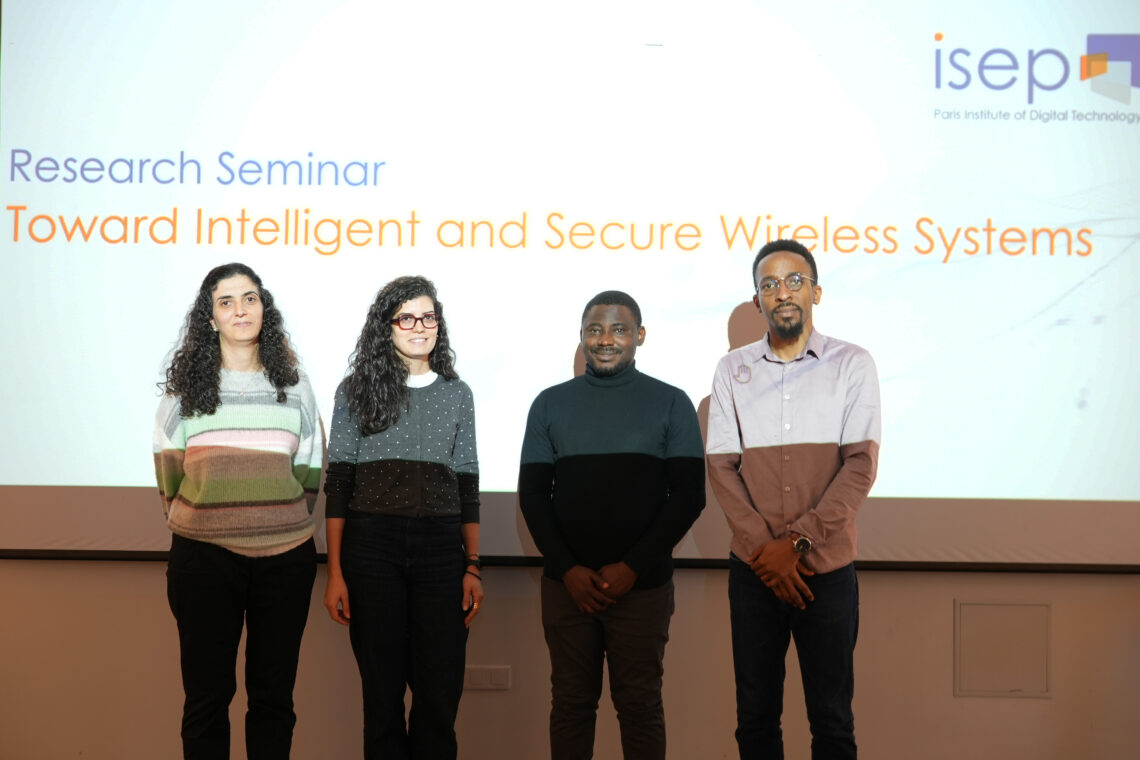
Isep is pleased to invite you to a research seminar dedicated to energy harvesting and sustainable electronic systems. The seminar will bring together academic experts to explore GaN technologies, hybrid perovskite materials, wireless sensing, IoT and future 6G communications, highlighting innovative approaches toward self-powered and energy-efficient digital systems.
Date: December 18, 2025
Time: 1:30 – 3:30 pm
Location: Isep, Notre-Dame de Lorette Campus, 10 rue de Vanves, 92130 Issy-les-Moulineaux
Room: L012
Isep and its LISITE research laboratory are holding a new seminar on the theme “Energy harvesting”.
The speakers will be:
-
Lionel TROJMAN, Director of Research, Isep
-
Lilian DAVID-EGBUNU, PhD student, Isep
-
Daqing ZHANG, Professor, Institut Polytechnique de Paris
-
Luan Chen, Associate Professor, ENSEA
Speaker n°1: Lionel TROJMAN, Director of Research, Isep
Title: Energy Harvesting and management: the GaN initiative!
Abstract:
The energy consumption of the human population continues to increase, as does the production of greenhouse gases responsible for climate change. Electronic devices, such as smart or connected objects, are being produced at an exponential rate, and IoT connections are growing accordingly. This does not even consider the data centers required to store and process these data, whose energy consumption is expected to explode by 2030, especially with the rapid adoption of AI technologies. Considering that, on average, 60% of global electricity production still comes from fossil fuels, it is not difficult to understand why the widespread use of digital devices makes them a major contributor to GHG emissions through their energy demand. One way to address this challenge is, first, to make digital devices as independent as possible from centralized energy sources, thereby reducing the reliance on fossil-fuel-based electricity. Second, renewable energy production must become more efficient and more reliable so that it can serve as the primary source of electricity.
In this presentation, we will revisit the concept of energy harvesting and discuss how it can be integrated into smart objects. This line of work remains largely at a fundamental research stage in terms of Societal Readiness Level (SRL) and Technology Readiness Level (TRL). Nevertheless, the use of gallium nitride (GaN) materials for integrated circuits (GaN-IC technology) offers a promising approach. It also opens the door to logic-level power electronics, with potential applications in intelligent photovoltaic grid systems.
Speaker n°2: Lilian DAVID-EGBUNU, PhD student, Isep
Title: Stabilization of FAPbI₃ Perovskite using 3D/2D Heterostructure Design for Stable and Efficient Electronic Devices.
Abstract:
As our world becomes more connected, the growing demand for self-powered and energy efficient electronic systems has intensified interest in materials that combine strong light harvesting abilities, high charge carrier mobility, and long-term structural stability. Metal halide perovskites, particularly formamidinium lead iodide (FAPbI₃), have exceptional light absorption and carrier transport properties, making them suitable for solar cells and other light-powered devices. However, they are unstable and quickly lose their photoactive black α-phase, which readily converts into the non-photoactive yellow δ-phase at room temperature. To address this challenge, we performed first-principles Density Functional Theory (DFT) simulations using QuantumATK to study a 2D/3D hybrid perovskite architecture. We analysed the geometry, band structure, optical absorption, and projected density of states of the 3D α-FAPbI₃ perovskite and its 2D analogue, BA₂FAPb₂I₇. Our results show that the 2D perovskite is stable and electronically compatible with α-FAPbI₃, meaning the 2D layer can help maintain the desired black phase of the 3D perovskite while still allowing charges to move freely which is essential for any energy-harvesting device.
Overall, this suggests that 2D/3D hybrid perovskites could offer a practical path toward more durable and high-performing solar cells, photodetectors, and self-powered electronic system
Speaker n°3: Daqing ZHANG, Professor, Institut Polytechnique de Paris
Title: Preparing every home for Ageing-in-Place with wireless sensing
Abstract:
With the ubiquitous deployment of Wi-Fi and 4G/5G infrastructure in each country, WiFi/4G/5G-based contactless sensing has become an ideal way for health and daily activity monitoring of elders in a non-intrusive manner, making every ordinary home suitable for Ageing-in-Place. In this work, I will introduce a series of WiFi/mmWave based vital sign and continuous daily activity monitoring systems for elders using home-owned WiFi/mmWave infrastructure. With the Wi-Fi sensing standard IEEE 802.11bf and 6G standard containing sensing capabilities rolling out soon, it’s expected that wireless sensing will bring significant changes to sectors such as smart home, elderly care, health care and smart buildings.
Speaker n°4: Luan Chen, Associate Professor, ENSEA
Title: Sensing-aided Channel Estimation on mmWave Band: A CS Perspective in V2X Scenario
Abstract:
In this talk, we aim to address the problem of channel estimation for mmWave MIMO system in vehicle to everything (V2X) scenario by leveraging sensing information obtained from a co-located radar at the base station, primarily including the location information represented by the time of flight (ToF) and angle of arrival (AoA), to reduce the pilot overhead. In addition, estimating channel coefficients over a wideband and across multiple antennas incurs significant resource overhead in terms of resources occupied for sending pilot symbols. However, it has been observed that the mmWave channel exhibits a sparse behavior with only a few resolvable multi-paths in angle and delay domain. By leveraging such sparsity, we also aim to adopt compressed sensing (CS) based approaches for channel estimation in mmWave MIMO systems. In the end, relevant case studies in several EU/ANR projects will also be demonstrated to reveal a promising roadmap to future 6G research from the perspective of integrated sensing and communications (ISAC).
About LISITE – Isep Research Laboratory
LISITE is made up of the DaSSIP group, which brings together skills in image, signal, data and computer processing, and the ECoS group, which brings together skills in electronics and communication systems.
These two groups interact within the framework of multi-disciplinary and collaborative projects in 4 areas of research:
- Digital for environmental health ;
- Massive and heterogeneous data processing in distributed systems;
- Integrated circuits, embedded systems and connected objects;
- Cybersecurity and data protection.